
What this document is
The standard for identifying, verifying, classifying and maintaining the resources and partners the Consortium refers Veterans to — and for retiring the ones that no longer work.
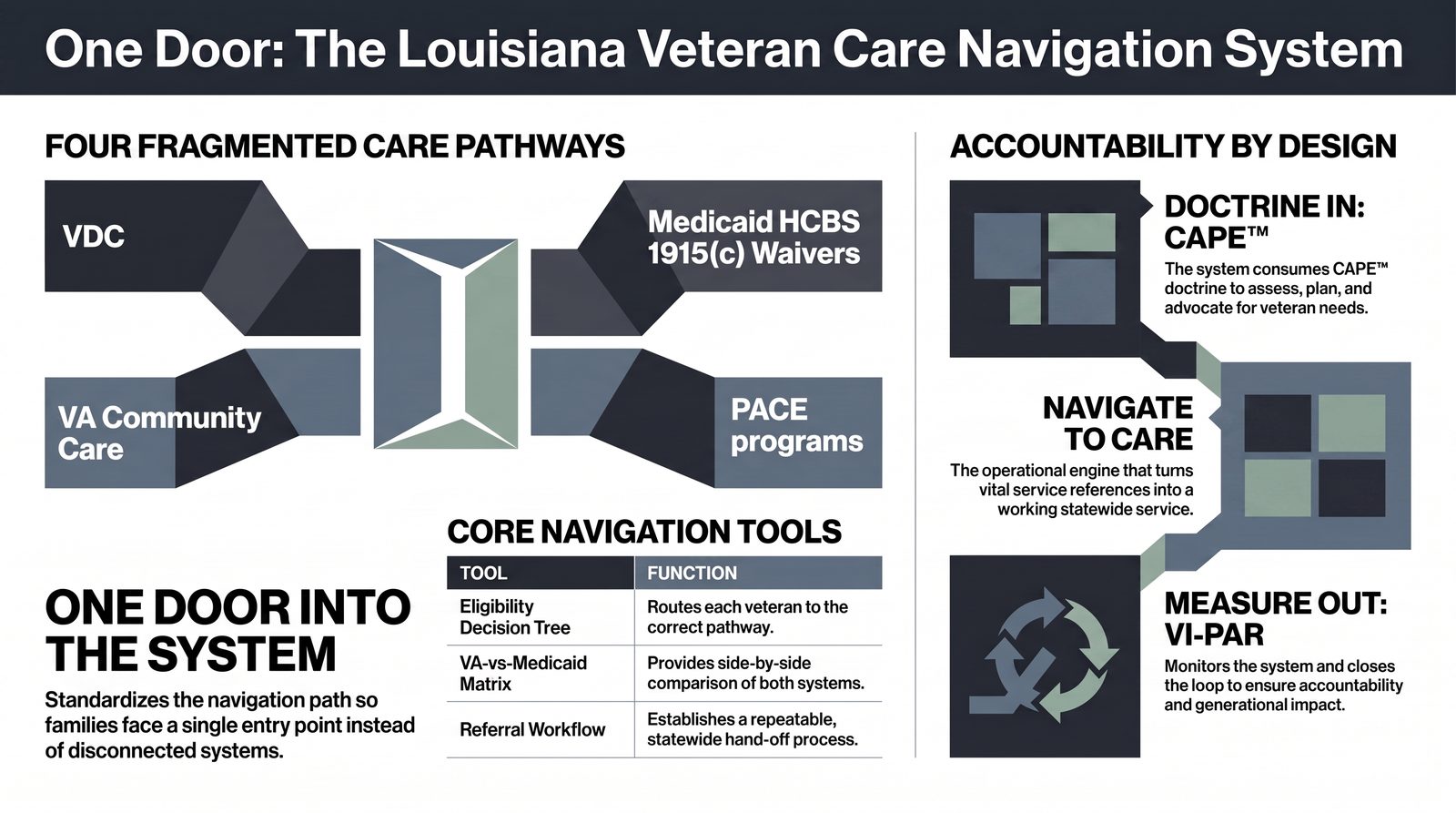
The problem it solves: veterans and caregivers face The problem it solves: most resource directories are lists of phone numbers that were true once. A Veteran sent to a closed programme, a full waitlist or an eligibility wall does not experience a directory error. They experience being turned away again.. The framework standardizes the path so families face one door, not many.
It is designed to become a VINE™ is the intelligence layer of the operating philosophy — VINE informs, VI-PAR measures, CAPE empowers. Its technical specification is the Enterprise Resource Mapping & Partnership Integration standard (ERM-PLI). and a repeatable reference for the navigation team, with VI-PAR™ monitoring closing the loop.
A directory is not a resource map
A listing tells you an organisation exists. It does not tell you whether they are accepting referrals this month, whether this Veteran qualifies, how long the wait is, whether transport is possible, or whether anyone followed up last time.
A resource becomes operational only when eligibility, capacity, accessibility, referral pathway, accountability, cost and outcomes are all known and continuously monitored.
Everything else in this standard follows from that single distinction.
What we record about every resource
Service domain, provider, legal entity, geographic coverage, delivery modality, target population, eligibility requirements, referral method and documentation requirements.
Cost to the participant, funding source, current capacity, wait time, accessibility, language availability, transport requirement and digital-access requirement.
Evidence of effectiveness, last verification date, data-sharing capability, emergency or routine status, and partner relationship tier.
Eighteen service domains are covered — from benefits navigation and housing through legal, workforce, food and utilities, transport, digital access, disaster recovery, elder care, childcare, reentry and rural infrastructure.
Eight states, not two
Verified–Active means availability and intake pathway confirmed. Verified–Limited means active but constrained by geography, capacity or eligibility.
Conditional requires case-specific confirmation. Waitlisted means the programme is running but not enrolling. Temporarily Closed means intake is suspended. Funding Exhausted means the programme exists but cannot presently assist.
Unverified means nobody has independently confirmed it — and it must never be presented to a Veteran as available. Retired means discontinued or replaced.
Verification runs at least quarterly, and more often for emergency assistance, housing, utilities and disaster resources, where a stale record does the most damage.
Seven tiers of partner
Tier 1 Strategic — formal agreement, shared planning, referrals, data and performance review. Tier 2 Operational — a defined service or referral role. Tier 3 Resource — accepts referrals, limited integration.
Tier 4 Collaborator — participates in events, training and outreach. Tier 5 Stakeholder — advises, funds, regulates or is affected. Tier 6 Prospective — under assessment. Tier 7 Inactive or watchlist — capacity, compliance or responsiveness concerns.
The tiers exist to stop a business-card exchange from being reported to the Board as a partnership. Listing a partner is not an endorsement of quality and not a guarantee of availability.
Mapping the deserts
Resources are mapped at national, state, regional, parish, municipal and neighbourhood level, because a service available statewide is not available to someone without transport.
The map is built to expose absence as clearly as presence: resource deserts, transport barriers, duplication, overlapping coverage and unmet demand by domain and parish.
Deployment begins in the Florida Parishes with St. Helena as the rural hub, expanding through Greater Baton Rouge, New Orleans, Bayou and Acadiana as verified coverage allows.
What we measure
System health: coverage by service domain, verified-resource percentage, record freshness, duplication rate, resource-gap index, rural access disparity and network density.
Partner performance: response time, acceptance rate, completion rate, capacity utilisation, data completeness, participant satisfaction, agreement compliance and cost per successful referral.
The distinction that matters most: contact, referral, acceptance, service receipt, immediate outcome and durable outcome are six different measurements. Collapsing them turns a report into fiction.
The The intelligence layer for — the most build-ready operational system in the library. It consumes CAPE™ and the Vital Services reference and turns them into a working statewide service.
This anchor is a draft until leadership shapes it. As you read:
- Which service domain has the thinnest verified coverage in our parishes?
- How often can we realistically re-verify — and who owns that?
- Which partners should be removed rather than remediated?